OBJECT // UNKNOWN
HARROW // NOTE

Interactive artwork. Swipe or use the left and right arrow keys to inspect the room. Use Tab to reach discoverable objects.
01 NOTHING HERE CAN BE EDITED. Not by me. Not by a board. Not by a court with a printer.
02 NOTHING HERE CAN BE SEIZED. Your copy sits in your wallet. Nobody holds it for you. Nobody can hold it against you.
03 NOTHING HERE ASKS PERMISSION. No gatekeeper. No platform. No app store. No "community guidelines." I'm the publisher, the press is mine, the chain is nobody's, and I print whatever I feel like saying.
FREE SPEECH IS THE HOUSE STYLE.

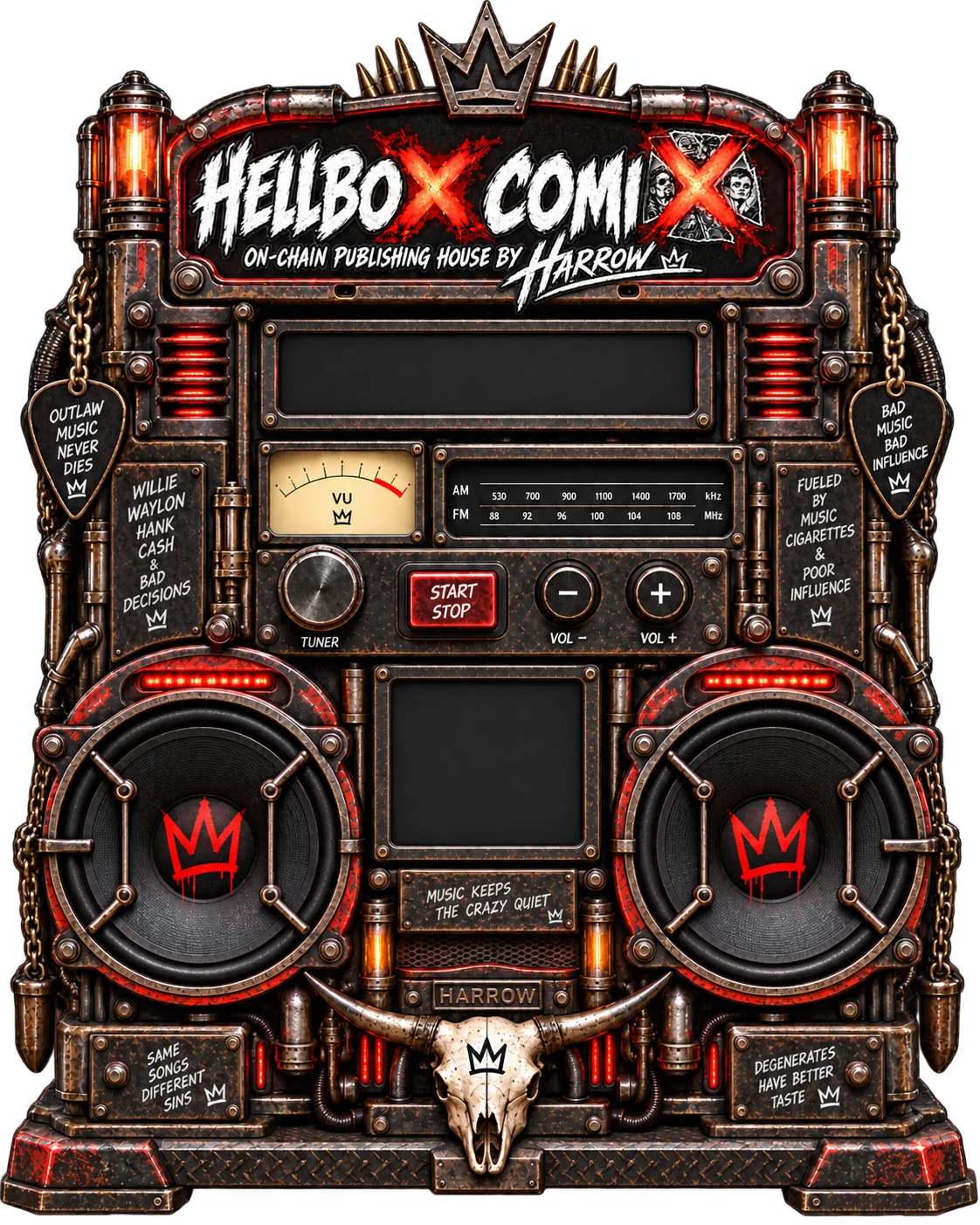
I'm listening too. I judge people by this. Not harshly — accurately. The whole shop runs on one soundtrack and you're about to choose it, so choose like someone worth knowing.
Tuner, Start/Stop, volume — on the machine, or on the little deck that follows you around the building. Same knobs. The deck is for people who can't sit still. I built it for me.
Submit a track if you think you have better taste. You don't. Submit it anyway.
RUNNING BRAVE? Brave ignores my Start button. Its rule, not mine. Open the little deck at the bottom-left — the player itself is in there. Press play on that. Shields up or down makes no difference; the click has to happen inside the player. Every other browser: the knobs work.
Three knobs. You've worked a toaster. You'll live.
Running Brave? Read the red note. Everyone else: go. — H.
I make graphic fiction about crypto because reality keeps writing drafts and frankly the dialogue needs work.
I built the machine that sells them because apparently everybody else thought a wallet button and a JPEG counted as an experience. I don't manage a community and I don't cater to one. I build the work and I leave the assembly room unlocked. Whatever forms in there forms on its own and runs itself. If it starts telling me the logo looks great, I'll be in the other room. The logo looks great.
NO STUDIO. NO COMMITTEE. NO ADULT SUPERVISION. WRITTEN // DRAWN // BUILT // OPERATED BY HARROW.
Actually I have 47.
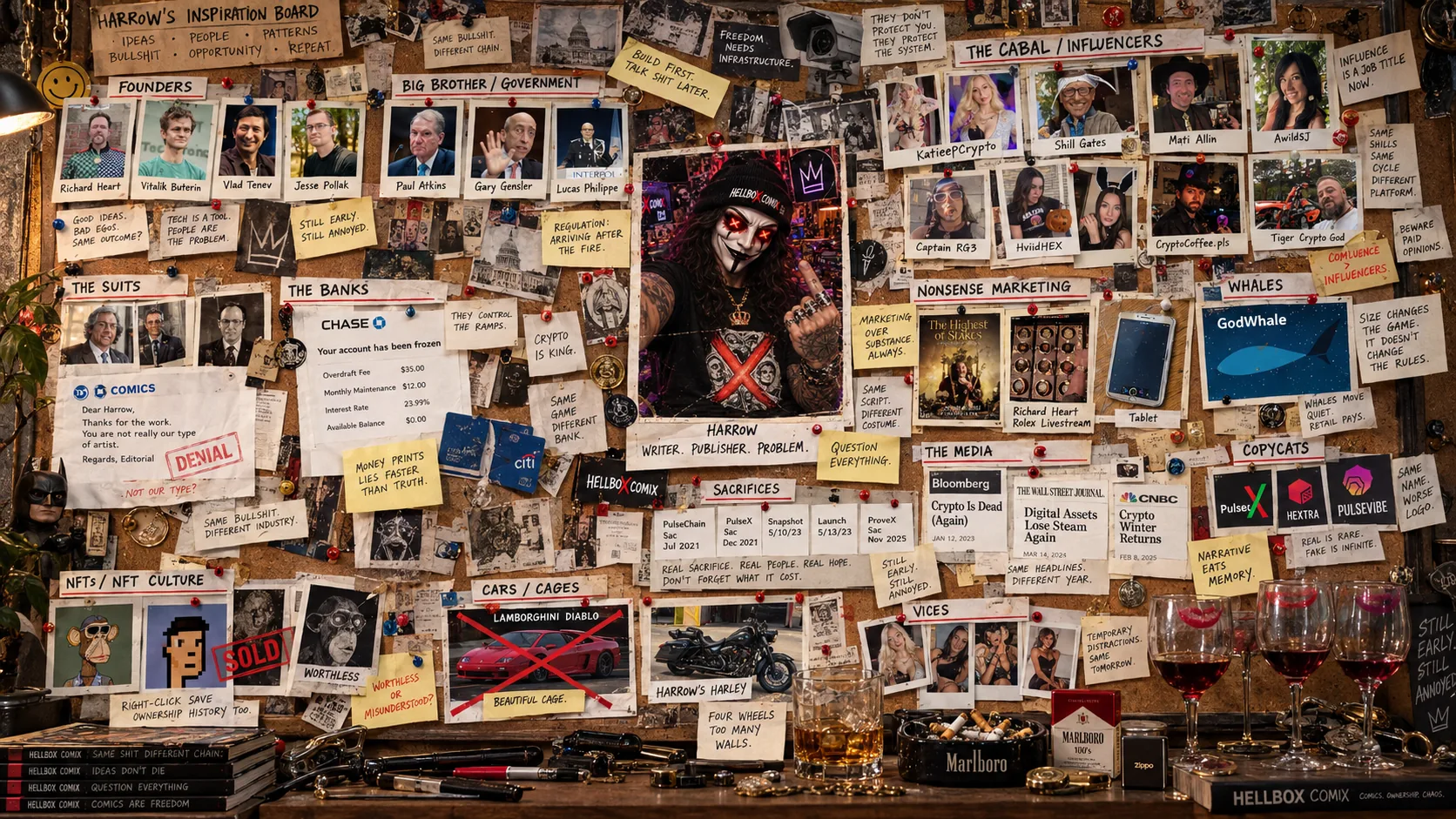
Fourteen of them are pinned up here. They got in, they stayed, they took the place over.
They can't live in my head forever. So they go on paper. Then through the press. Then to you.
This one has string.
Interactive inspiration board. Swipe or use the left and right arrow keys to inspect it. Use Tab to reach the fourteen pinned theories and the shelf.
THIS GOT OUT OF HAND
At some point crypto stopped being something I watched and became something I thought about while brushing my teeth.
Founders. Regulators. The cabal. Whales. Banks. The suits. The headlines. The copycats. Money. Ego. Tribalism.
Eventually the thoughts needed somewhere to go. So I gave them panels. Every pin on that board is a page I owed somebody.
Comics first. Collecting second. Ownership third. The blockchain is the plumbing, and I don't put plumbing on the wall. What I do put on the wall are the rules — because I cut them into the plate, and I can't change them either. Not me, not a board, not a regulator with a strongly worded letter. That's not a feature. That's the whole idea.
This is how every Hellbox native title by Harrow is built. Every time. Outside creators using the Press get to write their own rules — copy counts, archivability, all of it — and their titles are theirs, not mine. Below is mine.
Every copy comes off the press with a mark — most STANDARD, a few not — and sometimes a defect. Both are decided by the machine, at the press, forever. Rarity isn't a tier list. It's what survived the print run.
Unopened, like it came off the press. Sealed copies are the only ones that can be archived — put under plastic — and archived copies are the ones eligible to earn.
You'll be warned. Once the seal is broken it stays broken. Unsealed copies can never be resealed and never archived again. Read it or keep it. Choose like an adult.
Some pages end the normal way. Some end in a room you get to escape before the story goes on — a reward for reading closely, not a punishment. Decisions have consequences. Some endings are better than others. Some of the rewards kill you.
Some copies will be worth more transformed than kept. Owner's choice, never mine, and the fire always gives something back. Details when I'm ready. Bring an unsealed copy — you read it first, then you feed it.
| Mark | Copies |
|---|---|
| HELLBOUND | 6 |
| PRESS PROOF | 12 |
| GOLD | 18 |
| STANDARD | 180 |
| Defect | Copies |
|---|---|
| REDACTED | 6 |
| CORRUPTED PLATE | 12 |
| BLED OUT | 18 |
| OFF REGISTER | 24 |
| NONE | 156 |
Every native issue gets its own clock the moment it opens, and they run side by side. When one hits zero, that issue's unpressed copies are destroyed and its final three come to me. None has ever been paused. None can be. I made sure.
PLATES CUT // CLOCKS ARMEDDrawn blind from the same pool as yours, so the copy inside could be anything — HELLBOUND, REDACTED, both. It doesn't earn until it's claimed. It doesn't move until someone solves the way in. The way in is a room. I'm not going to say where. And when somebody finally walks out with it, a new wallet and a new room spin up behind them and the whole thing starts again. It doesn't end. That's the point.
This is the DeFi part, and it's boring on purpose. These aren't promises. They're contract facts. If I wanted to change them I'd have to cut a new plate, and everyone would watch me do it.
No custodian. No admin key that rewrites your copy. No terms page that quietly changes on a Tuesday. The part they'd like to regulate is the part that can't be reached.
Don't take my word for it. Every address below is real and on-chain. Click one for its explorer and read what it does and why the house needed it. This is what is running today — work that hasn't opened yet gets listed here the day it opens, and not before.

SciVive is Richard Heart's book. Every word of it is his — Mind, Body, Spirit, Money, Power, Respect, the rest. I didn't write a line of it. I pressed it: put it on a chain, gave it a plate and a number, and stapled my own foreword to the front telling you exactly what I think of him. That's the whole arrangement. He wrote it. I run it through my machine.
He gave it away first — free, no rights held back, built to spread. I'm doing the same thing on four chains instead of one, because a demonstration that only works once isn't a demonstration. Every copy, on every chain, is the same proof: a book that lives permanently on-chain, owned outright by whoever pressed it, that nobody — not the platform, not the founder, not me — can take back. I built the machine to run anywhere from day one. PulseChain first, because that's where I opened the doors. Robinhood, Base and Ethereum after it, because the proof doesn't count unless it survives past the first chain I opened them on.
Why you want it: it's free, it's yours the second it lands, and it exists at all despite the man who wrote it going on camera to explain why nothing like it should work. 5,555 of them. One per wallet. Then it's gone.
— H.
You'll see it when I decide it's finished.
So never.
It looks complicated because I wanted it to. It's five taps, in order, same every time.
A red arrow on the machine points at whatever is next; the thing it points at flashes, and the plate up top keeps count. The rest of the machine still works if you want to drive it yourself: the card slot under START plugs your wallet in early, the issue dial and the little keypad screen show odds and stats instead of a menu now, QTY sets how many when a book allows more than one (SciVive is one per wallet, and the plate doesn't negotiate). Need it stopped now? The emergency shutoff is bolted to the wall beside it, wired straight into the tower: one hit and everything dies, no questions, and it stays in until you wake the machine again. The little speaker button shuts it up. You pay the chain its gas and the press its ink — a flat fee, in that chain's own coin, that prepays the second transaction, the one that decides which copy you got. What the copy itself costs is on the screen before you pull anything; SciVive costs nothing. Truly can't be bothered? THE EASY PASS does it for you and charges you for the privilege. I'll judge you.
Nothing here can be undone. Good. — H.
Interactive publishing machine, five steps: turn it on, check the chain dial, pick a book, hit the big red button, shut it off, or go again. Use Tab to reach START and the other controls.

SciVive costs nothing. That's the book — that run, not a promise about everything this press will ever print; what a copy costs is on the screen, always. Two other things are not nothing. The chain you're on charges its own gas for your transaction, which goes to the network and moves with traffic. And the press collects a flat fee on top, in that chain's own coin, every pull, free runs included. That fee isn't the book and it isn't profit: pressing takes two transactions, and the second one — the one that actually decides which copy you got — is sent for you moments later without you signing again. It prepays that transaction and goes straight to the wallet that sends it. Your wallet shows you the whole total before you agree to anything.
Connect your wallet. It's a ledger, not a diary. Privacy already lost this argument.
Everything from this house, sorted the way a publisher sorts things: comics, then ebooks; mine, then everyone else's; sealed, opened, or under plastic. What you don't own is here too, with a note on whether the Press still has it.
Your shelf, your books, your problem now.
Reading is allowed. Breaking the seal is a decision. A tattoo is a confession. — H.
Show me the wallet.
THE READER // OWNER-ONLY // THE POINT OF ALL OF THIS
Your wallet is the ticket. If a copy is in it, the Reader opens it — nobody else's, no screenshots of somebody's tab, no "preview." Sealed copies stay sealed until you break the seal, and breaking it is the one thing in this building I can't undo for you.
SciVive reads like a book — the whole thing, every word the way Richard wrote it, on the chain. However many pages that comes to in your hands is how many pages it has. This is the official copy now. A Wild SJ reads it to you if you ask; my notes sit in the margins if you let them; double-tap a word and I'll tell you what it means. Native issues read like a night out: some pages end, some open into rooms, and the room decides whether you get the next page. Everything you do in there is yours. Nothing you do in there changes what the Press printed. Later, the whole shelf goes in your pocket.
Connect a wallet and I'll tell you which ones followed you home.
Eventually. This terminal walks a creator from "which chain" to a deployed title the same way the Press walks you to a pull: one prompt at a time, no committee, no permission slip. Your book. Your rules. My machine.
Right now it answers to one person. Look through the glass all you want. Bad ideas welcome. Half-finished garbage is not.
Seven screens. One red button. A keypad from 1994.
Bad ideas welcome. Half-finished garbage is not. — H.
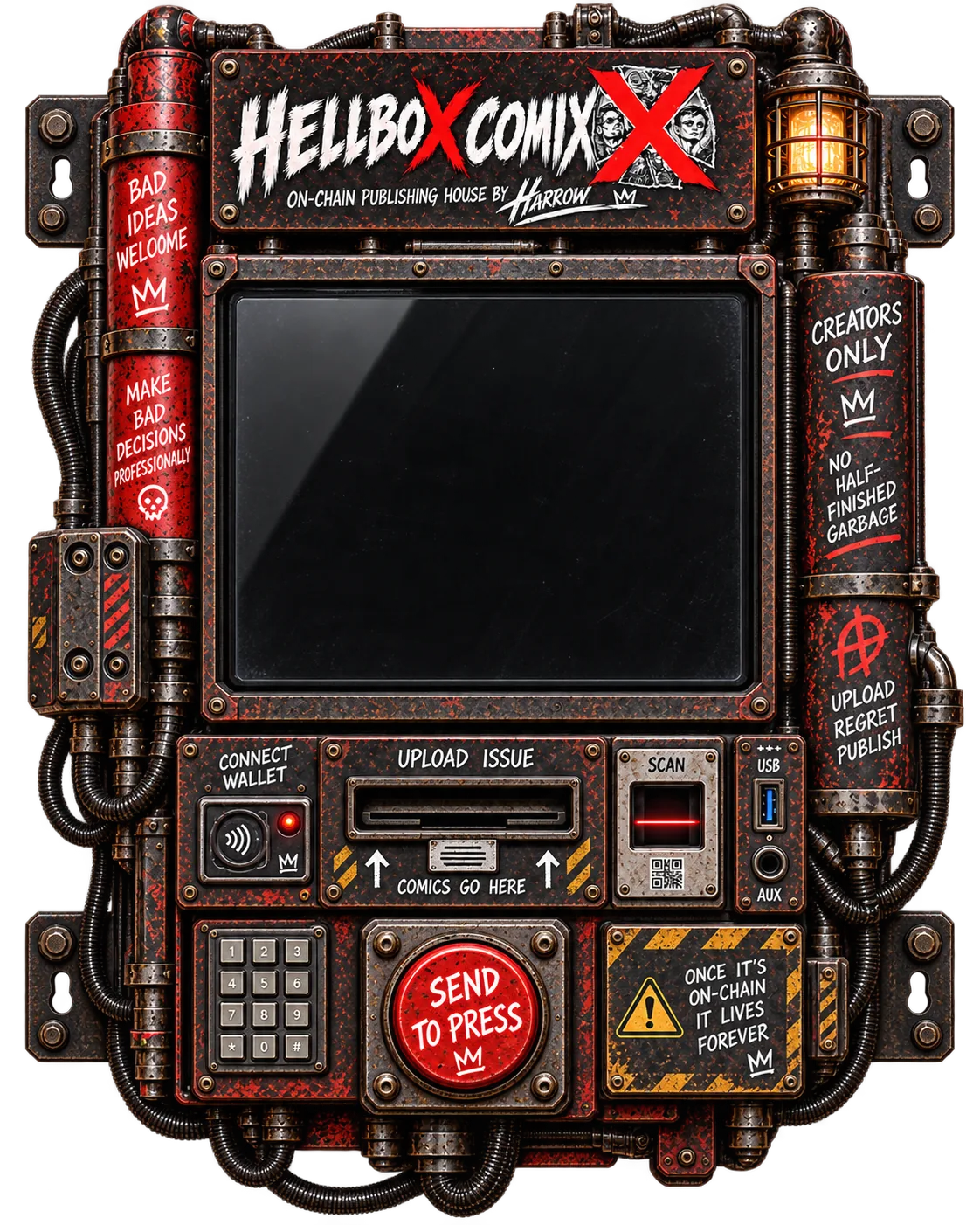
Keypad enters numbers. # confirms, * goes back. The red button does exactly one thing, and once it's on-chain it lives forever. The label on the machine isn't a joke.
Independent titles are yours: your royalty, plus a flat 2% rider to the house for the Press, and 2% of primary. You host your own pages. You never get my stamp, and you never need it.
Your contract published readable, source and all, so anyone can check what it does instead of taking your word for it. You don't install a toolchain, you don't flatten anything, you don't spend a night arguing with an explorer. You send the title to the press; it's done when you look.
More will hang on this board as the terminal opens. Anything listed here is a thing the house actually does, not a thing it intends to.
Every machine in this building runs on something. The gauge is here. The label isn't. When it's time, it'll read like it was always going to — because it was.
Obviously. No. YET.
The simplest machine in the building.
When there's a step three, you'll know. — H.
The name is redacted. The math isn't. Every fee this house takes, every royalty a copy earns me on the way to somebody else's wallet, gets cut in three. Same knife every time.
It launches on Pump.tires when enough PLS has pooled from what this house sells. Bonding curve, then PulseX. Liquidity burned, ownership renounced, one billion, never more. I buy first — two thirds at the gate — and cut that the same way: a third burned, a third to the archive, a third to the press. When it happens I'll be loud about it. Until then the label stays black.
Nothing earns before the launch. Archive now if you like the sleeve; the meter starts the day the fuel exists, not a minute before. If it ends up interesting you as more than a rewards token — you heard it here, early. That's the whole tip.
One more thing feeds the line, and it isn't open yet. The basement doesn't pay rent. It can't. Three tenants, zero dollars, one lease term: every drop of ink they burn, they buy through me. The house's cut of that ink walks through the same knife: a third burned, a third to the archive, a third to the press. Two weeks.
I post things.
Sometimes they're even relevant.
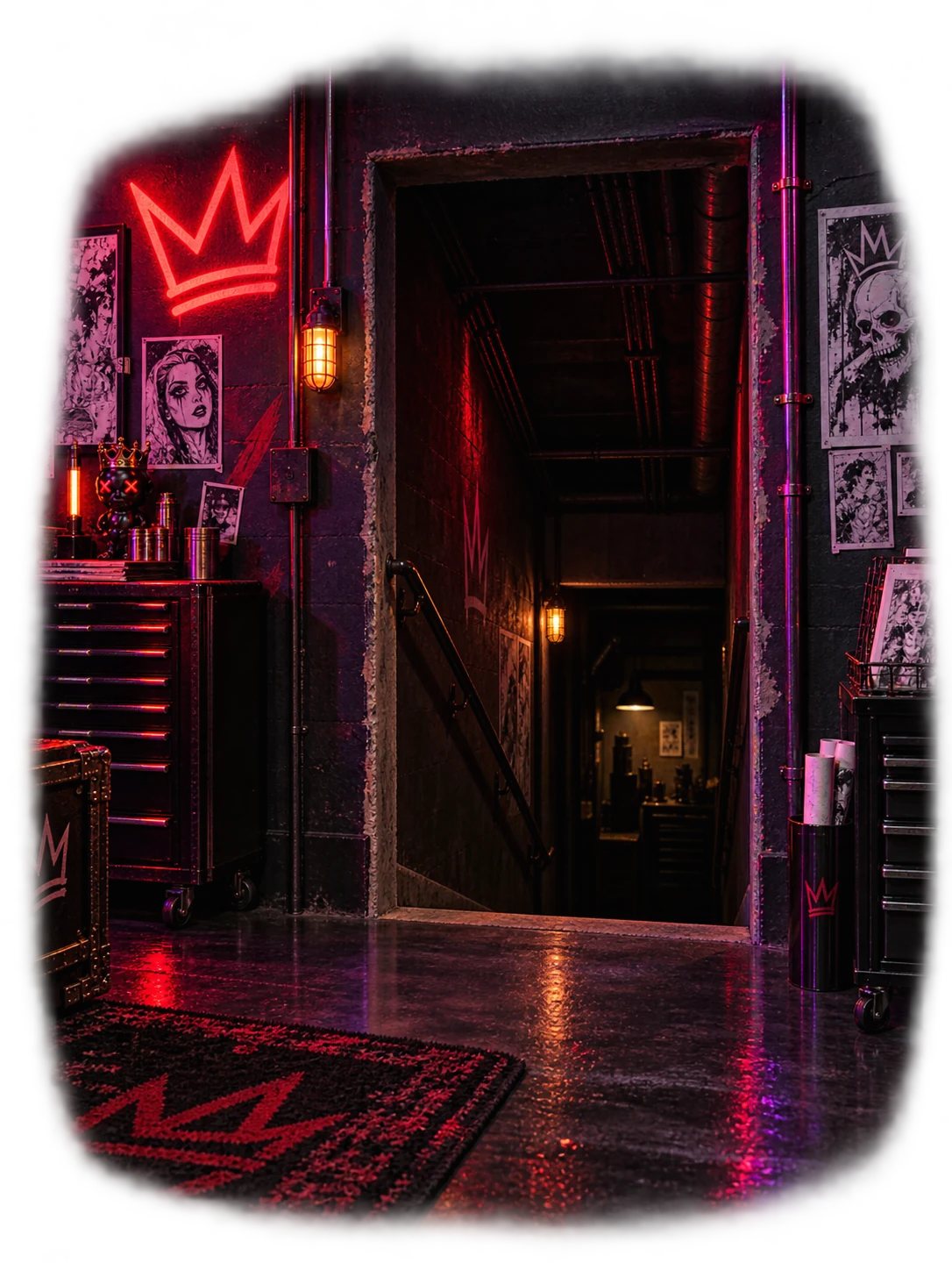
I don't go down there. Three of them live in it. Not one can make rent, so they pay in ink. Mine.
A Ponk with a box by the door. It's full. It says FREE.
A dead Pirate with a tattoo machine and a counter.
A Byte who takes in strays.
A tattoo is not a token. Ask them why.
THE STAIRS GO DOWN. YOU DON'T. NOT YET.NFT Drop · ERC-721
Because OpenSea is a store, not a press. Minting there means their contract, their fees, their terms, their front page. You'd be renting a shelf. Hellbox is a publishing house: the press writes the copy's own paperwork as it prints — the press number, the mark, the defect, sealed or unsealed, the Prize Wallet, the Hellion file. No marketplace's mint button knows how to do any of that.
Because OpenSea doesn't reach PulseChain. It lists Robinhood Chain; it does not list PulseChain at all. Half the press would be standing where they can't see it.
Selling it later is your business. Every copy is a plain ERC-721. On Robinhood Chain it shows up on OpenSea by itself; on PulseChain it trades on PulseChain's own markets. We don't care who resells a copy. We care who prints it.
Powered by somebody else™ · Terms · Privacy · No refunds on dignity